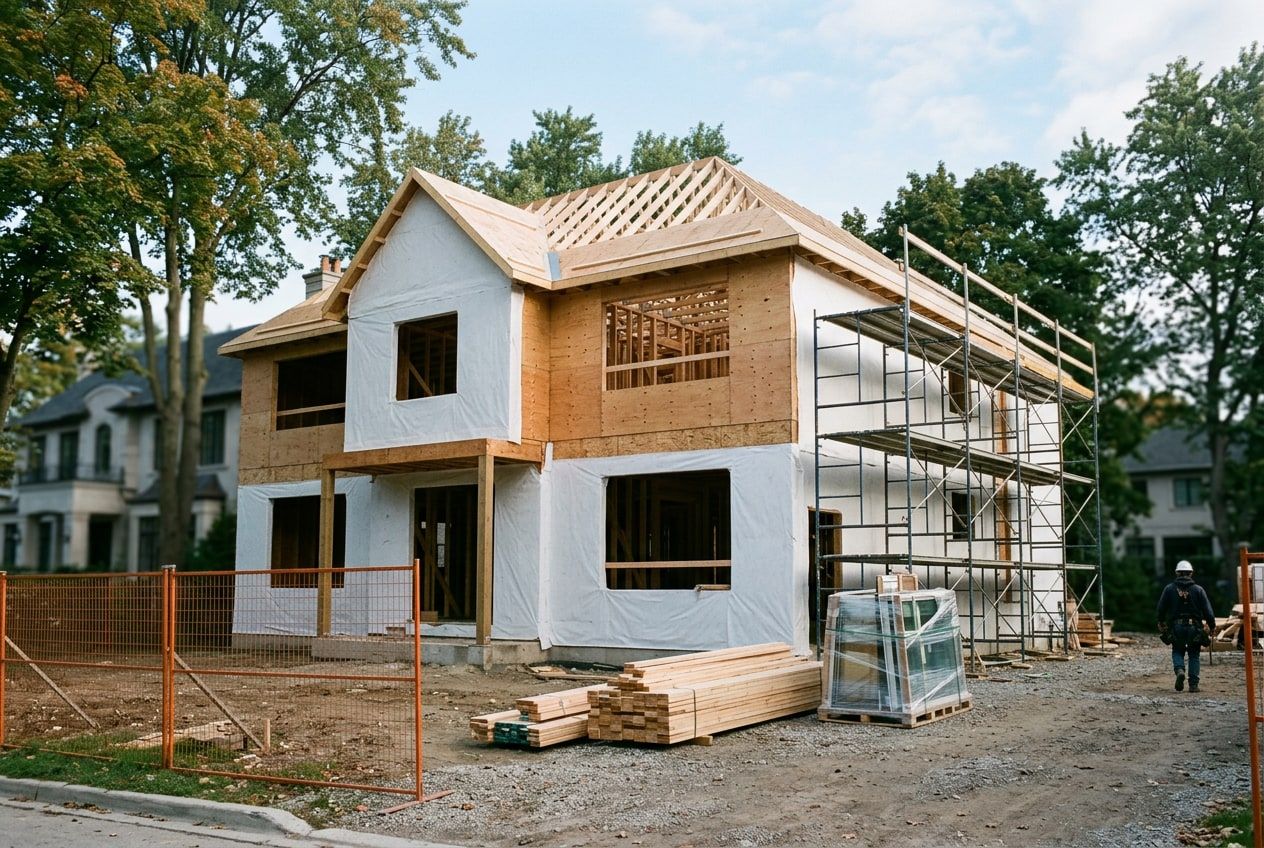
Builder’s risk wordings are long, often 50 to 100 pages or more once the liability section and endorsements are included. This is a plain-language guide to what’s typically inside: what’s covered, what’s excluded, and the conditions you have to meet. Every policy is different, so treat it as a list of questions to ask, not a description of any one policy.
For the basics, including who buys builder’s risk and how it differs from your contractor’s insurance, see Steve’s page on builder’s risk insurance.
Two kinds of policy
Both of these get called builder’s risk, but they work differently:
| What differs | Course of construction | Renovation or vacancy |
|---|---|---|
| Typical use | New builds and structural projects | Gut renovations of an existing home |
| What’s insured | The project as it’s built, up to its completed value | The existing house, with the renovation added |
| Who’s insured | Often the owner plus every contractor, subcontractor and consultant on site | Usually the owner only |
| Materials off site | Often covered in transit and storage, up to a set amount | Often covered at the site only |
| How it’s priced | Often a provisional premium, adjusted to the actual completed value at the end | A fixed limit, sometimes with a co-insurance clause |
| Main conditions | Fire safety, site security and keeping work going | Site checks, heat or drained plumbing, staying within the described scope |
A renovation or vacancy policy is often written for a specific, described scope of work, for example cosmetic, non-structural renovation only. If the project is bigger than that, it needs to be described properly from the start.
What’s usually covered
- The building or project, including fixtures, and the materials for the work.
- Fire, wind, theft and vandalism, on an “all risks” basis, subject to the exclusions and conditions.
- Temporary works such as scaffolding, forms and hoarding, and sometimes site preparation and landscaping, when they’re included in the limit.
- Debris removal, often as part of the overall limit rather than on top of it.
- On many course of construction policies, a set of smaller extras, usually with their own limits: expediting costs to speed up repairs, extra expense, fire department charges, the cost of preparing a claim, replacing plans and drawings, and breakdown during testing and commissioning.
- An existing building on the site is usually covered only if it’s specifically added.
Common add-ons, often with their own limits and deductibles
- Flood, sewer backup and earthquake. These are often optional, and each can carry its own, larger deductible. Some reduce a claim if the overall limit is set too low.
- Equipment breakdown, for systems like heating and electrical once they’re installed.
- Building code and by-law upgrades after a loss.
- Soft costs and delay, such as extra interest, taxes, fees and lost rent if a loss pushes back completion. These usually have a waiting period before they start.
- Liability for the owner, where it isn’t already included. Some owner’s liability sections cover only your ownership of the site and exclude claims arising from the construction work itself.
Common exclusions
- Faulty workmanship, materials or design. The cost to fix the defect itself is excluded. Damage it causes, like a fire or flood, may be covered.
- Water and weather: groundwater seeping through the foundation is commonly excluded, and many renovation policies also exclude rain or snow coming in through openings in the walls or roof that an insured peril didn’t create. Keep the site tarped and closed in.
- Freezing and temperature changes are often excluded, though damage from a burst pipe may be covered depending on the wording and whether the conditions were met.
- Settling, cracking and shifting, and structural work like underpinning, on many renovation policies unless it was disclosed and approved.
- Mould, asbestos, pollution, and the extra cost of meeting newer building codes or by-laws unless added.
- Delay, loss of use and penalties for finishing late, unless soft costs or delay coverage were added.
- Theft without a trace (“mysterious disappearance”) and theft by anyone working on the project.
- The contractors’ own tools and equipment.
Conditions and warranties: the fine print that decides claims
Every builder’s risk policy comes with conditions you have to meet. Depending on the wording, breaking one can suspend coverage, remove coverage for a related loss, or in some cases void the policy. Which conditions apply depends on the type of policy.
Common on renovation and vacancy policies
- Stick to the described scope. If the work grows beyond what was described on the application, for example from cosmetic to structural, or an addition appears, tell your broker before it starts.
- Regular site checks. Someone checks the building at least every few days (often every 72 hours), keeps a written log and fixes problems right away.
- Heat and water in winter. Keep the heat on, or shut off the water and drain the plumbing.
- Keep it locked. Doors and windows locked, and any alarm or sprinkler system working and monitored.
Common on course of construction policies
- Keep work going. Coverage can stop if the site sits unattended or work stops for a set period, often 30 days, apart from planned seasonal shutdowns.
- Fire safety warranties. Combustible waste removed daily or kept in a metal bin, no burning without a permit, clear access for the fire department, a fire watch after torch and roofing work, extinguishers close by, and heaters of an approved type set up with proper clearance.
- Pass the rules on. Some policies require the owner to give these warranties to the contractor in writing and post them on site, and coverage can be lost if that isn’t done.
Common to both
- Your contractors’ insurance. Many policies require contractors, or at least key trades like framing, roofing, electrical and plumbing, to carry liability insurance at a set minimum before they start. On some renovation policies, failing that can void coverage entirely. Collect certificates of insurance before anyone starts work.
- Insure to value. Set the limit at the true completed or replacement value. Renovation policies may reduce a claim through a co-insurance clause if the limit is too low, and replacement cost is often paid only once you actually rebuild, without delay.
- Keep the site clean. Daily clean-up, and no rubbish piled in or around the building.
Claims, and when coverage ends
- Report claims right away, protect the property from further damage, call the police for theft or vandalism, and expect to sign a sworn proof of loss.
- Your lender should be listed on the policy, as mortgagee or loss payee. It isn’t automatic, so check that it’s shown.
- Moving in can end the coverage. Many policies stop once the home is occupied or put to use, though some allow certain uses before completion. Confirm with your broker, and have the regular home policy ready to start that day.
- The term is fixed. If the project runs past the policy’s end date, it has to be extended before it expires.
- Contractors and recovery. Under many course of construction policies, the contractors are insured on the policy and the insurer gives up its right to recover from them. Under a home or renovation policy, the insurer may recover from the contractor’s insurer if the contractor was at fault.
Questions to ask before work starts
- Is this a course of construction policy or a renovation or vacancy policy?
- Does the described scope of work match what we’re actually doing?
- What’s the limit based on, and does it reflect the finished value?
- Are materials covered in transit and in storage, and up to how much?
- Are flood, sewer backup and earthquake included, and what are their deductibles?
- What conditions do we have to meet, and has the contractor been given them in writing?
- Which contractors need their own liability insurance, and do we have their certificates?
- Is our lender listed?
- When does the policy end, and what happens if the project runs late?
- Does the policy include liability for us as owners, and does it exclude the construction work itself?
If you have a builder’s risk policy already, or you’re about to start a project, Steve will go through the wording with you and point out the conditions you’ll need to meet. It’s much easier to get right before the work starts.
Common questions
Is a renovation policy the same as builder's risk?
Not always. For a renovation of an existing home, the policy is often a property policy on the house with a vacancy permit, construction conditions and liability added, written for a described scope of work. For a new build, it's more often a course of construction policy written for the completed value, with the contractors insured on it too. Both get called builder's risk, but what they cover can differ a lot.
What conditions do builder's risk policies usually have?
It depends on the type. Renovation and vacancy policies often require you to stick to the described scope of work, check the site regularly (often every 72 hours) with a log, keep the heat on or the water shut off and drained in winter, and keep the building locked. Course of construction policies usually focus on fire safety: daily clean-up of combustible waste, no burning, hot work rules with a fire watch, safe heater set-up, clear fire department access, and proof that key trades carry liability insurance. Some require the owner to give these rules to the contractor in writing and post them on site.
What happens if I break a condition in my builder's risk policy?
It depends on the wording. A breach can suspend coverage, remove coverage for a loss connected to the breach, or in some cases void the policy. Some course of construction policies only deny a claim if the breach caused or contributed to the loss. Read the conditions before work starts and make sure everyone on site knows them.
Does builder's risk cover materials stored off site?
It depends on the policy. Many course of construction policies cover materials in transit and in off-site storage up to a set amount, though often not while they're being manufactured. Many renovation and vacancy policies cover materials only at the site. If you're storing windows, cabinets or appliances somewhere else before they're installed, ask your broker before you rely on the policy.
When does builder's risk end?
Usually at the end of the policy term, when construction is complete, or when the building is occupied or put to use, whichever comes first, depending on the wording. Many policies also end or restrict coverage if the site is left unattended or work stops for a set period, often 30 days, apart from planned seasonal shutdowns. If the project runs long, the policy needs to be extended before it expires.
Does builder's risk cover faulty workmanship?
Generally not. The cost to redo poor workmanship or fix a design error is usually excluded, although damage that results from it, like a fire or flood, may be covered depending on the wording.
Why is builder's risk insured for the completed value?
Because there's no practical way to insure a house at each stage of completion as it's built. The policy is written for what the home will be worth when it's finished, so it's there whether the loss happens at the foundation stage or at 80% complete. Many course of construction policies charge a provisional premium and adjust it once the actual completed value is reported at the end.